
April 6th, 2019
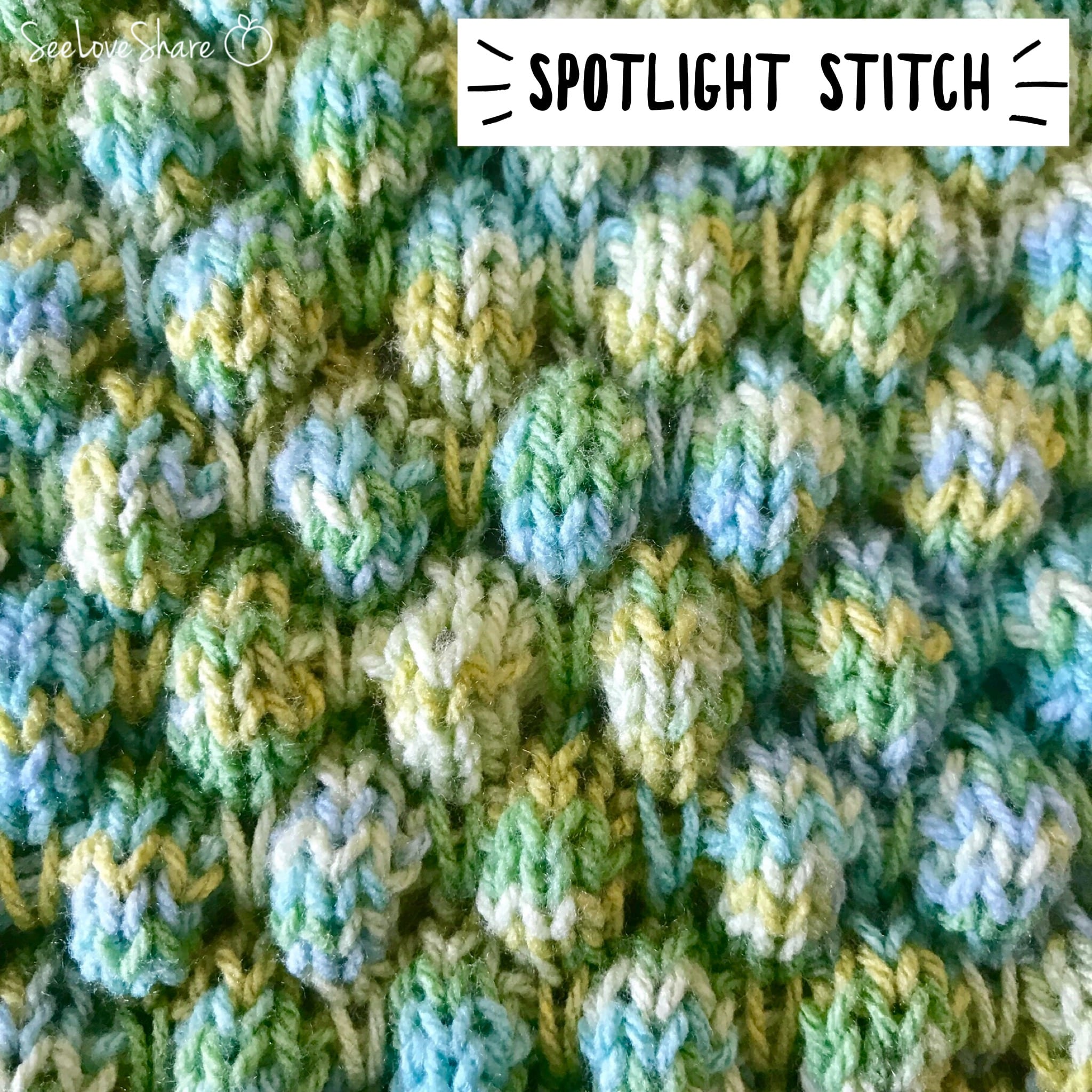
Spotlight Stitch: Knit Bubble Stitch
The knit bubble stitch is one of those magical stitches that looks far more complex than it actually is. Worked over a simple multi-row repeat, it creates raised, rounded “bubbles” that pop off the surface of your fabric — adding the kind of dimensional texture that makes a finished piece feel handmade in the best possible way. Whether you’re knitting a baby blanket, a cozy throw, or a textured pillow cover, this is a stitch worth having in your repertoire.
In this knit bubble stitch tutorial, you’ll find a complete written pattern with row-by-row instructions, a video walkthrough, common mistakes to avoid, and a list of patterns that put this stitch to beautiful use. Let’s get into it.
What You’ll Make with the Bubble Stitch
The bubble stitch shines in projects where texture is the star. It’s particularly beautiful in:
- Baby blankets — the soft, raised texture is perfect for snuggling and visually interesting in any colorway
- Throws and afghans — adds dimensional interest to an otherwise simple knit blanket
- Pillow covers — the tactile, sculptural quality makes a statement on a couch or chair
- Scarves and cowls — the bubbles catch the light beautifully and add visual depth
- Sweater panels — use it as a feature panel on a yoke, sleeve, or front piece
Materials & Gauge
- Yarn: Works beautifully in any weight, but worsted (#4) — like Red Heart Super Saver — or bulky (#5) — like Bernat Softee Chunky — shows off the bubble texture best
- Needles: Match your yarn weight — US 8 (5mm) for worsted, US 10 (6mm) for bulky, US 13 (9mm) for super bulky
- Cast-on: Any multiple of 4 stitches plus 2 (for example: 18, 22, 26, 30…)
- Gauge: Not critical for a swatch or accent piece. For a sized project, knit a 4″ x 4″ gauge swatch in the stitch pattern before casting on


For a deeper understanding of yarn weights and substitutions, the Craft Yarn Council yarn weight system is a helpful reference.
Abbreviations
- k — knit
- p — purl
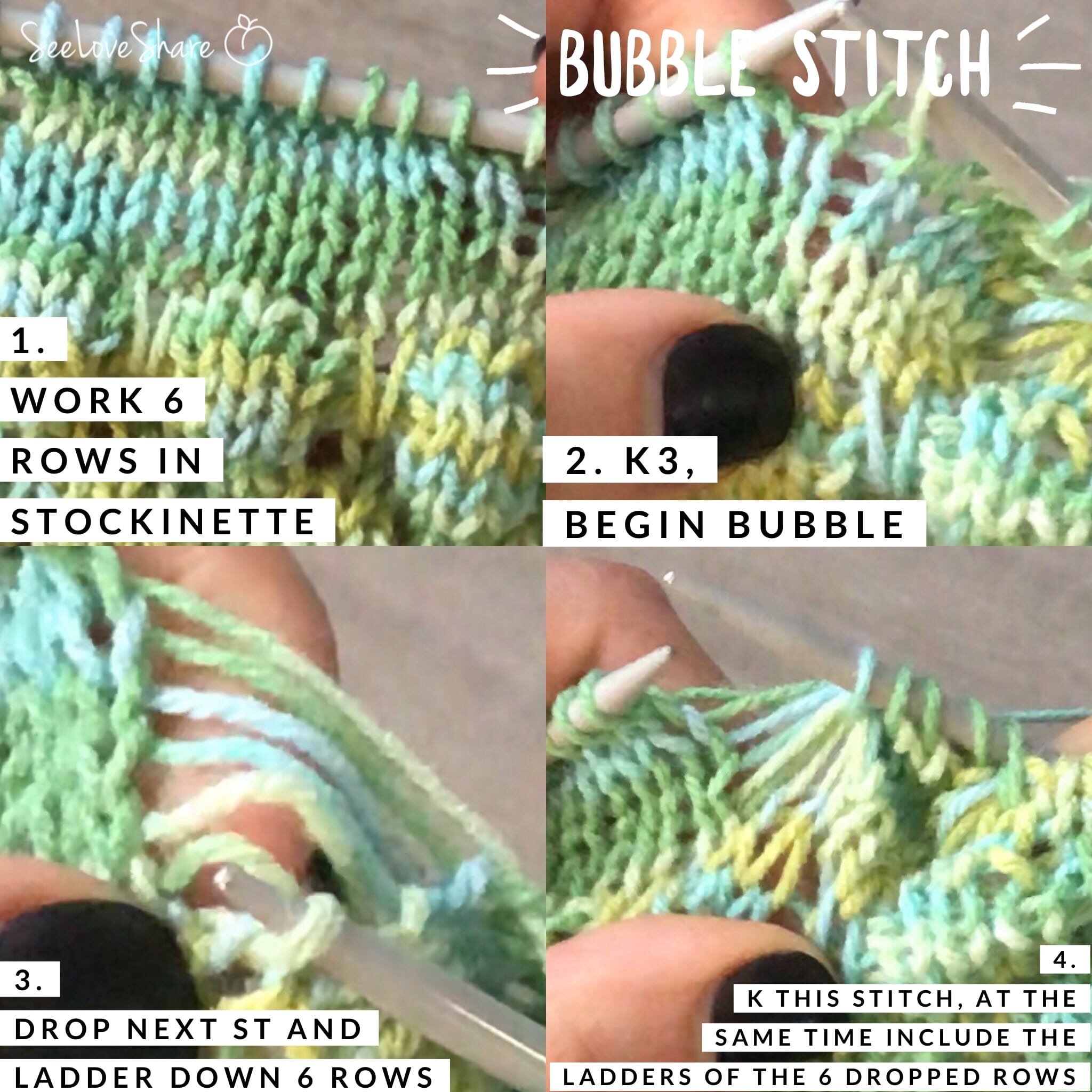
- k1b — knit 1 below (insert needle into the stitch one row below the next stitch on the left needle, knit it, and let the stitch above drop off — this creates the “bubble”)
- st(s) — stitch(es)
- rep — repeat
Knit Bubble Stitch — Written Pattern
Worked over a multiple of 4 stitches plus 2.
Row 1 (RS): Knit all stitches across.
Row 2 (WS): Purl all stitches across.
Row 3 (RS): K2, *k1b, k3*; repeat from * to * across to the last stitch, k1.
Row 4 (WS): Purl all stitches across.
Row 5 (RS): Knit all stitches across.
Row 6 (WS): Purl all stitches across.
Row 7 (RS): K4, *k1b, k3*; repeat from * to * across to the last 2 stitches, k2.
Row 8 (WS): Purl all stitches across.
Repeat Rows 1–8 for pattern. The offset between Row 3 and Row 7 creates the staggered bubble pattern that gives this stitch its signature look.
Watch the Video Tutorial
If you learn better by watching than by reading, here’s the full video tutorial showing exactly how to work the knit bubble stitch from cast-on to finished swatch:
Common Mistakes (and How to Fix Them)
My bubbles look uneven or saggy
This usually means your k1b stitches are being worked too loosely. When you knit into the stitch below, give the working yarn a slight tug to tighten the bubble. The k1b should feel snug but not strained.
My fabric is curling at the edges
Stockinette-based stitches naturally curl, and bubble stitch is no exception. Add a 4-stitch garter or seed stitch border on each side, and a few rows of garter at the top and bottom, to keep your work flat. A gentle blocking after finishing helps too.
I lost track of which row I’m on
The eight-row repeat can be tricky to track at first. Use a row counter or place a stitch marker at the start of Row 1 each time you begin a new repeat. Once you’ve worked through two or three repeats, you’ll start to recognize the visual rhythm and won’t need the counter.
My stitch count keeps changing
The k1b stitch looks like it should change your stitch count because you’re dropping the stitch above, but it doesn’t — you’re working into the row below the next stitch, not adding or removing stitches. Count carefully across the row to confirm. If your count is off, you’ve likely missed a knit or k1b somewhere mid-row.
Patterns That Use the Bubble Stitch
Ready to put your new stitch into a project? Here are a few patterns from the blog that feature the bubble stitch beautifully:
 Ombre Knit Baby Blanket Pattern — Pink Bubble Stitch Design — the bubble stitch in a soft ombre, perfect for baby shower gifts
- Bobble Knit Baby Blanket Pattern — a closely related textured pattern using the bobble stitch (similar look, different technique)


More Spotlight Stitch Tutorials
Love learning new stitches? Explore more from the Spotlight Stitch series:
- Waffle Stitch Tutorial (Crochet) — a textured grid that works up beautifully in dishcloths and afghans
- Blackberry Stitch Tutorial (Crochet) — a sweet, bumpy textured stitch with the same hand-feel as bubble stitch in knit


Frequently Asked Questions
Is the knit bubble stitch good for beginners?
Yes — if you’re comfortable with knit and purl stitches, you can learn the bubble stitch. The only new technique is “knit 1 below” (k1b), which sounds intimidating but is actually one of the easier increase-style stitches to master. Practice on a swatch of about 18 stitches before starting a larger project.
What’s the difference between bubble stitch and bobble stitch?
They’re often confused but they’re different techniques. The bobble stitch creates a 3D ball of yarn that’s worked into a single stitch over multiple rows. The bubble stitch uses the “knit 1 below” technique to create a softer, more subtle raised texture across multiple stitches. Bobble = chunky popping balls; bubble = soft, allover dimensional texture.
Can I work the bubble stitch in the round?
Yes, with a small adjustment — when working in the round, your “wrong side” purl rows would need to be worked as knit rows (since you’re always on the right side). The pattern adjusts to: knit all rounds 1, 2, 4, 5, 6, 8; work the k1b on rounds 3 and 7. The visual result is similar but a touch different from flat knitting.
How much yarn does the bubble stitch use?
About 10–15% more than standard stockinette of the same dimensions. The k1b stitches pull a tiny bit of extra yarn into each bubble, which adds up over a larger project. Buy a little extra yarn if you’re cutting it close.