
Sweaters & Cardigans All Adult Patterns Crochet
November 24th, 2026
Sweater Size Chart and Ease Guide for Knit and Crochet (XS to 5X)
This sweater size chart takes the guesswork out of choosing a size for any knit or crochet sweater or cardigan. It gives you the standard bust measurements from XS to 5X in inches and centimetres, the five levels of ease every pattern is built on, and a simple 3-step method to pick the right size the first time.
If you have ever finished a sweater only to find it tight across the chest, or so roomy it looks borrowed, the problem usually isn’t your stitches. It’s one number on the size chart that most makers read the wrong way. Let’s fix that.
Quick answer: To choose a sweater size, measure the fullest part of your bust, decide how much ease you want (2 to 4 inches for a classic fit), then pick the size whose finished bust equals your bust plus that ease. Example: a 38 inch bust plus 4 inches of ease needs a 42 inch finished bust. On a standard sweater size chart that is a size M, not an S.
In this guide
Sweater Size Chart: Standard Bust Sizes XS to 5X
Most knit and crochet patterns, including mine, grade their sizes to the same body measurements. This sweater size chart shows the bust (or chest) each size is designed to fit. These are body measurements, not the measurements of the finished sweater.
| Size | To-fit bust (inches) | To-fit bust (cm) |
|---|---|---|
| XS | 28–30″ | 71–76 cm |
| S | 32–34″ | 81–86 cm |
| M | 36–38″ | 91.5–96.5 cm |
| L | 40–42″ | 101.5–106.5 cm |
| XL | 44–46″ | 111.5–117 cm |
| 2X | 48–50″ | 122–127 cm |
| 3X | 52–54″ | 132–137 cm |
| 4X | 56–58″ | 142–147 cm |
| 5X | 60–62″ | 152.5–157.5 cm |
Every pattern also has its own finished measurements table, usually beside the schematic. That second table is the one that tells you how the sweater will actually fit, and it is where most sizing mistakes happen.
Men’s sweater size chart
Making a sweater for him? Men’s sizes are measured around the chest and run larger than women’s at the same letter. A men’s M fits roughly the same chest as a women’s L.
| Men’s size | Chest (inches) | Chest (cm) |
|---|---|---|
| S | 34–36″ | 86–91.5 cm |
| M | 38–40″ | 96.5–101.5 cm |
| L | 42–44″ | 106.5–111.5 cm |
| XL | 46–48″ | 116.5–122 cm |
| 2X | 50–52″ | 127–132 cm |
| 3X | 54–56″ | 137–142 cm |
| 4X | 58–60″ | 147.5–152 cm |
| 5X | 62–64″ | 157.5–162.5 cm |
Most women’s patterns can be made for a man. Pick the size by chest measurement plus ease, exactly as you would for your own sweater, then lengthen the body and sleeves to suit his height. Men usually prefer a classic or loose fit, so 4 inches of ease is a safe starting point.
Finished Bust vs To-Fit Bust: The #1 Sizing Mistake
A pattern size chart usually lists two bust numbers for each size:
- To-fit bust: the body the size is made for.
- Finished bust: the measurement around the finished sweater.
Here is the mistake. You measure 38 inches. You scan the chart, see a finished bust of 38 inches under size S, and pick S. It sounds logical, but that sweater is exactly your size with no room at all. It will feel snug, pull across the back and ride up when you lift your arms.

The size actually made for a 38 inch bust is M. Its finished bust is 42 inches, which is 4 inches bigger on purpose. That extra room is called ease, and the designer has already built it in for you.
The rule: find your bust in the to-fit row. Only use the finished bust row when you want a fit that is closer or looser than the designer intended.
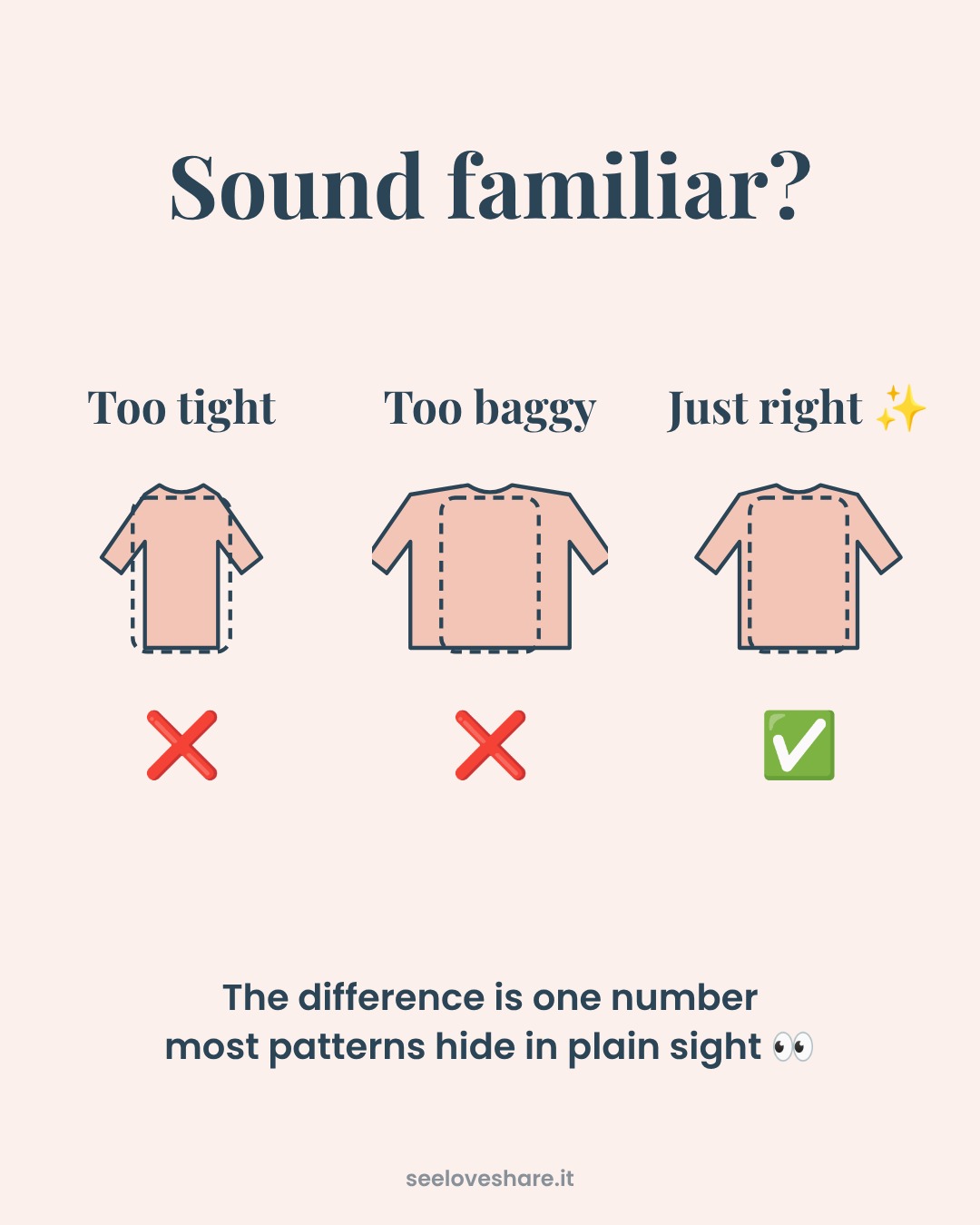
What Is Ease in Knitting and Crochet?
Ease is the difference between the finished sweater and your body. It is the room to move, and it decides whether a sweater looks fitted, classic or oversized.
Ease = finished bust − your bust
- Positive ease: the sweater is bigger than you. A 42 inch sweater on a 38 inch bust has 4 inches of positive ease.
- Zero ease: the sweater is exactly your size. It skims the body.
- Negative ease: the sweater is smaller than you and stretches to fit. This is common in ribbed tops and fitted knits.

Ease isn’t a mistake in the pattern, and it isn’t something you need to subtract. It is a design choice. Two sweaters can have the same stitches and look completely different because one has 2 inches of ease and the other has 8.
Ease matters for hats and socks too, only in the other direction. Hats use negative ease so they stay on. My hat size chart explains how much to take off for a beanie.
Sweater Ease Chart: How Much Ease Do You Want?
The Craft Yarn Council groups fit into five levels. Use this sweater ease chart alongside the sweater size chart above to decide how roomy you want your finished sweater.
| Fit | Ease | What it looks like |
|---|---|---|
| Very close fitting | −2 to −4″ (−5 to −10 cm) | Smaller than you and stretches to fit. Ribbed and stretchy fabrics only. |
| Close fitting | 0″ | Body skimming. Your exact bust measurement. |
| Classic fit | +2 to 4″ (5 to 10 cm) | Comfortable everyday fit. The safe choice for most sweaters. |
| Loose fit | +4 to 6″ (10 to 15 cm) | Relaxed, easy to layer over a shirt. |
| Oversized | +6″ or more (15 cm or more) | Slouchy, with dropped shoulders and plenty of drape. |

How much ease for a cardigan?
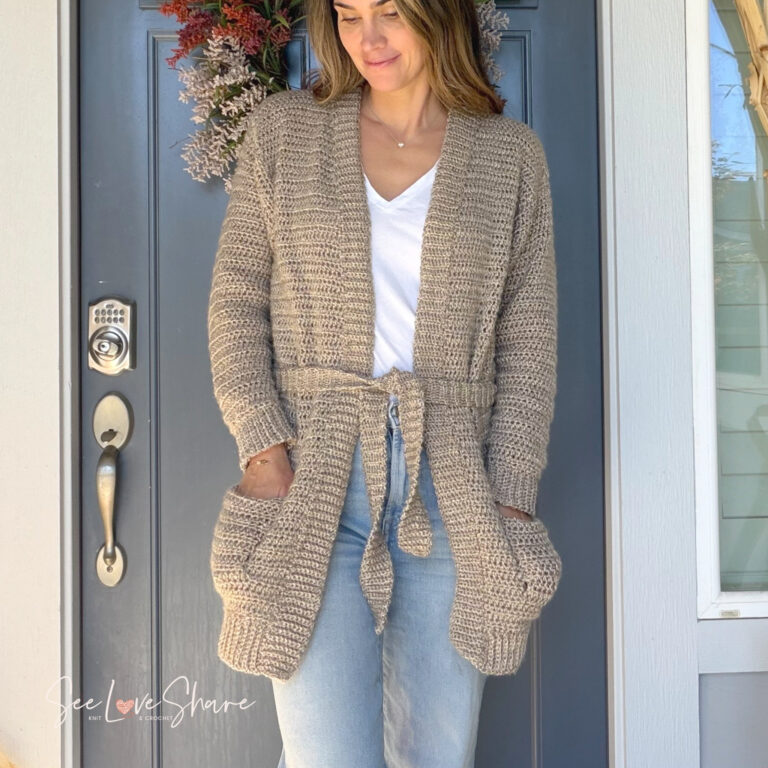
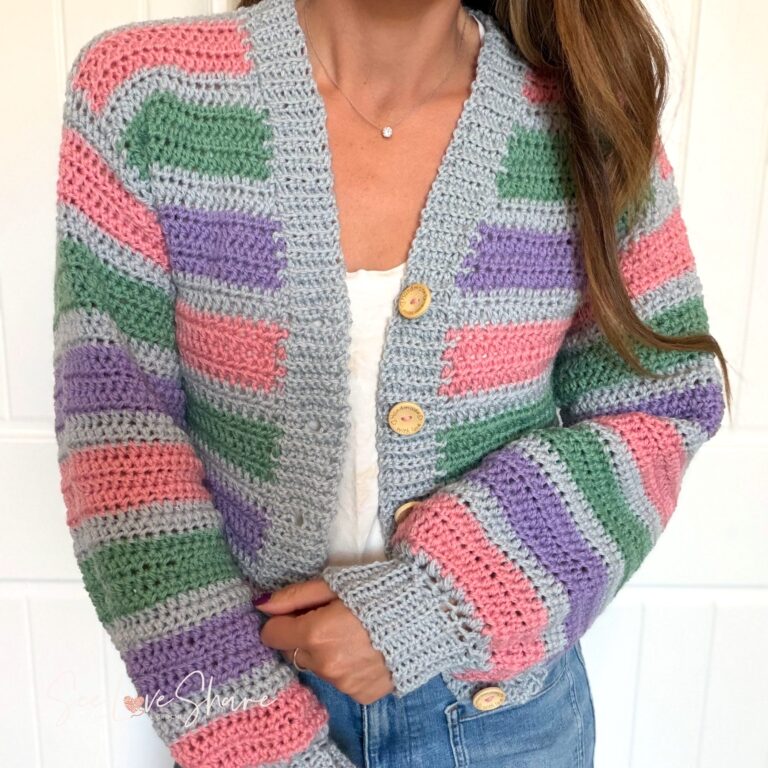
Cardigans are usually worn over another layer, so most sit at 4 to 6 inches of ease. A cropped cardigan worn on its own can go closer. My Striped Crop Cardigan has 0 to 2 inches of ease in sizes XS to M for a neat, cropped fit, while My First Cardi has 4 inches at XS to M, rising to 6 inches in the larger sizes, for a relaxed long cardigan.
How much ease for a pullover?
A classic pullover usually has 2 to 4 inches. Lacy or open stitches like granny clusters drape more, so they look good with a little extra. The Sunday Granny is designed with about 4 inches of ease, so a 38 inch bust wears a size M with a 42 inch finished bust.
Does yarn change how much ease I need?
Yes. Bulky yarn and dense crochet stitches add thickness, so they feel tighter than the tape says. Add an extra inch for chunky yarn or textured stitches. Stretchy fibres like wool rib can take less ease, while cotton and acrylic hold their shape and need the full amount.
How to Use a Sweater Size Chart in 3 Steps
Once you know your bust and the fit you like, any sweater size chart becomes easy to read. Here is the method I use for every pattern.
- Measure your bust. Example: 38 inches.
- Add your ease. For a classic fit, add 4 inches: 38 + 4 = 42 inches.
- Match the finished bust. Find 42 inches in the pattern’s finished bust row. In the Sunday Granny, that is size M.

This works in both directions. If you love the way a sample fits the model but you want it closer, subtract ease instead and pick a smaller finished bust. If you want an oversized look, add 6 or more inches and size up.
Tip: check the pattern photos. Most patterns say which size the model wears and her bust measurement. Do the subtraction and you will know exactly how much ease the photo shows.
How to Measure Your Bust for a Sweater
A sweater size chart is only as good as the number you bring to it. You need a soft tape measure and about a minute.
- Wear the bra or base layer you plan to wear under the sweater.
- Wrap the tape around the fullest part of your bust, under your arms and across your shoulder blades.
- Keep the tape level all the way around. Check in a mirror that it hasn’t dipped at the back.
- Breathe normally and keep the tape snug but not tight.
- Read the number where the tape overlaps. That is your bust measurement.

Making a sweater as a gift? Measure a sweater the person already loves instead. Lay it flat, measure straight across just under the arms and double it. That is the finished bust they like, so you can match it directly in the pattern’s finished measurements.
Measure your upper arm too if you are between sizes or have fuller arms. Sleeves are often the tightest part of a handmade sweater, and many patterns list the upper arm in their finished measurements.
Other Measurements on a Pattern Size Chart
Bust decides your size, but a good pattern lists more than one measurement. Here is what the rest of a sweater size chart tells you and when to change it.
- Length: measured from the top of the shoulder to the hem. This is the easiest measurement to change. Add or remove body rows before the hem band and the fit across the bust stays the same.
- Upper arm: the circumference of the sleeve at its widest point. Measure your own upper arm and look for 1 to 3 inches of ease here, more if you plan to wear the sweater over a long-sleeved top.
- Armhole depth: the drop from the shoulder to the underarm. Too shallow and the sweater pulls when you lift your arms. Top-down sweaters let you try this on before you join the body.
- Sleeve length: usually measured from the underarm to the cuff. Arm length follows your height, not your bust, so many patterns use the same sleeve length for every size. Hold the sleeve up to your arm as you go and stop when it reaches your wrist.
- Neck width: rarely an issue, but a wide neck on a smaller frame can slip off the shoulders. A narrower collar band fixes it.
The schematic, the line drawing in the pattern, shows each of these as a labelled measurement. If the finished bust is right but the length or sleeves aren’t, you don’t need a different size. Adjust the rows and keep the size that fits your bust.
Between Two Sizes on the Sweater Size Chart?
It happens all the time, especially if your measurement lands right on the edge of a range. Choose by the fit you want, not by rounding.
- Size down for a closer fit, a stretchy fabric or a cropped style.
- Size up for a relaxed fit, a cardigan you will layer, or a dense, thick fabric.
- Check the shoulders. If you have narrow shoulders and a fuller bust, the smaller size often fits the shoulders better. Top-down patterns let you try the yoke on and adjust before you commit.
All three of my sweater patterns are worked top down and seamless, so you can slip them on as you go and check the fit across your shoulders and bust before you reach the body.
6 Common Sweater Sizing Mistakes (and Easy Fixes)
- Matching your bust to the finished bust. This gives you zero ease. Match the to-fit bust instead.
- Skipping the gauge swatch. Half a stitch per inch can change the finished bust of a sweater by 4 inches or more, which is a whole size. Swatch in the main stitch and measure it before you start.
- Measuring over a thick sweater. Measure over a thin layer, the way you will wear it.
- Ignoring the model’s size. If you love the fit in the photos, find out what size she wears and how much ease that gives.
- Forgetting the yarn. A super bulky yarn behaves very differently from the worsted in the pattern. Add ease for thick yarn.
- Sizing for the waist or hips. Pick by bust, then adjust the body length or add a little shaping. The bust and shoulders are the hardest parts to alter later.
Free Sweater Patterns to Try
Put the sweater size chart to work. Each of these crochet patterns is free on the blog in size small, with all nine sizes from XS to 5X in the printable PDF. Together they cover three different fits, so you can see ease in action.
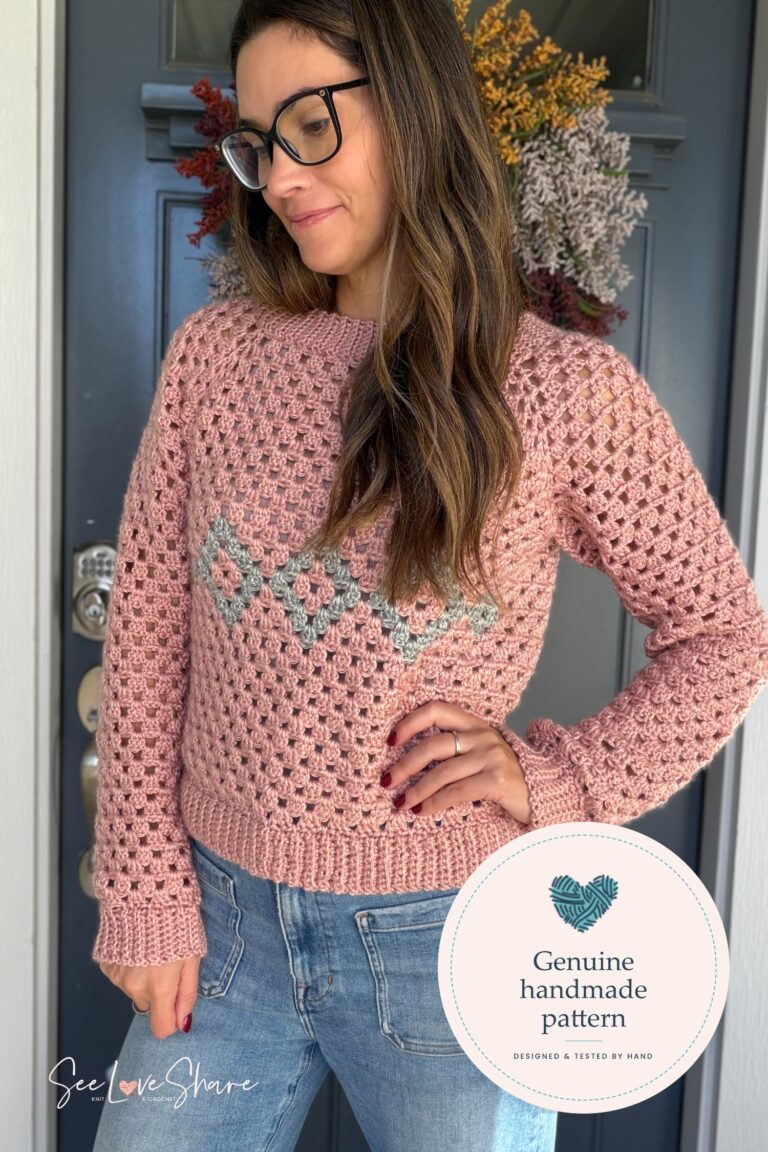
- Sunday Granny: a seamless top-down granny stitch pullover in Lion Brand Heartland, with an optional diamond colourwork band. One stitch the whole way down, no seams and no blocking.
- My First Cardi: a long, relaxed beginner cardigan with built-in pockets and not a single seam.
- Striped Crop Cardigan: a cropped, four-colour cardigan worked top down from one chain at the shoulders.
Making a blanket next? My standard blanket sizes chart covers everything from a lovey to a king.
Sweater Size Chart FAQ
How do I know what size sweater to make?
Measure the fullest part of your bust, add the ease you want (2 to 4 inches for a classic fit), then choose the size whose finished bust matches that number. A 38 inch bust with 4 inches of ease needs a 42 inch finished bust.
Should I go by the finished bust or the to-fit bust?
Go by the to-fit bust. It already includes the designer’s ease. Only use the finished bust when you want a closer or looser fit than the pattern intends.
What is ease in knitting and crochet?
Ease is the difference between the finished sweater and your body. Positive ease means the sweater is bigger than you, zero ease means it is your exact size, and negative ease means it is smaller and stretches to fit.
How much ease should a sweater have?
Most sweaters have 2 to 4 inches of positive ease for a classic fit. Use 4 to 6 inches for a loose fit and 6 inches or more for an oversized look.
How much ease does a cardigan need?
Most cardigans have 4 to 6 inches of ease because they are worn over another layer. A cropped cardigan worn on its own can have 0 to 2 inches.
What size sweater is a 38 inch bust?
A 38 inch bust is a size M on a standard sweater size chart, which fits a 36 to 38 inch bust. In a pattern with 4 inches of ease, size M has a 42 inch finished bust.
What if I am between two sizes?
Choose by the fit you want. Size down for a closer fit or a stretchy fabric, and size up for a relaxed fit, a layering cardigan or a thick yarn.
Is the sweater size chart the same for knit and crochet?
Yes. Body measurements and ease are the same for both crafts. Only the stitch count changes, based on your gauge.
How do I measure my bust for a sweater?
Wrap a soft tape around the fullest part of your bust, under your arms and across your shoulder blades. Keep it level and snug but not tight, and wear the layer you plan to wear under the sweater.
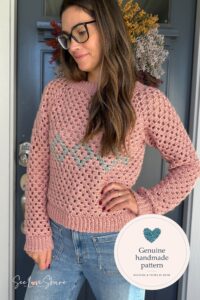 Granny Stitch Sweater Crochet Pattern: The Sunday Granny (Free, No Seams)
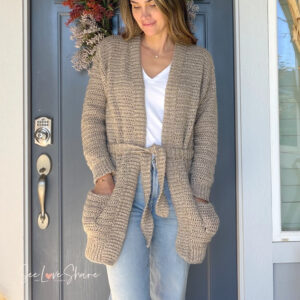 Beginner Crochet Cardigan Pattern: My First Cardi (Free, No Seams)
 Striped Crochet Cardigan Pattern: Free, Top Down, No Seams