
November 11th, 2019
Standard Hat Sizing Chart — Free Knit & Crochet Reference | SeeLoveShare
A well-fitted hat starts with the right measurements. This standard hat sizing chart for knit and crochet projects covers head circumferences and finished hat dimensions from newborn through adult — making it easy to choose the right size for any pattern you’re working from. Bookmark this page; you’ll come back to it every time you start a new hat project.
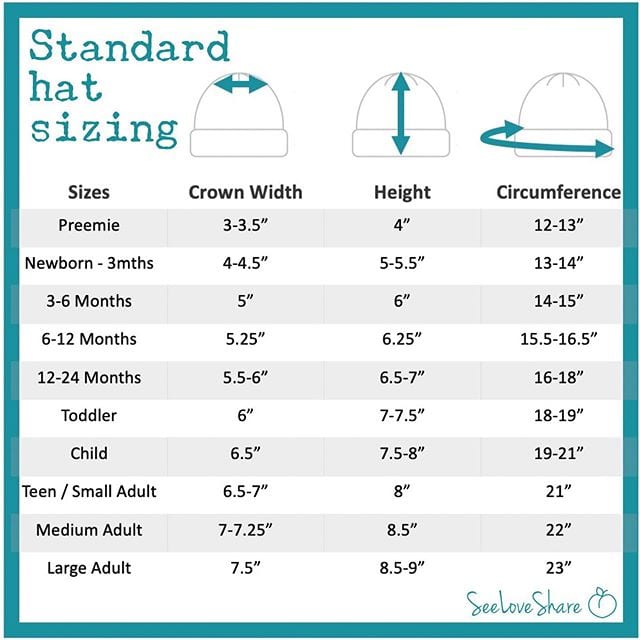
Standard Hat Sizing Chart
These are the standard hat sizes used across most knit and crochet patterns. Head circumference is measured around the widest part of the head, just above the ears.
| Size | Head Circumference | Crown Width (flat) | Hat Height |
|---|---|---|---|
| Preemie | 12–13″ | 3–3.5″ | 4″ |
| Newborn–3 months | 13–14″ | 4–4.5″ | 5–5.5″ |
| 3–6 months | 14–15″ | 5″ | 6″ |
| 6–12 months | 15.5–16.5″ | 5.25″ | 6.25″ |
| 12–24 months | 16–18″ | 5.5–6″ | 6.5–7″ |
| Toddler | 18–19″ | 6″ | 7–7.5″ |
| Child | 19–21″ | 6″ | 7.5–8″ |
| Teen / Small Adult | 21″ | 6.5–7″ | 8″ |
| Medium Adult | 22″ | 7–7.25″ | 8.5″ |
| Large Adult | 23″ | 7.5″ | 8.5–9″ |
Note: “Crown Width” is the flat width of the hat when laid out, measured from edge to edge — this is what you’ll measure your gauge swatch against. “Head Circumference” is the actual head measurement of the wearer. For a snug fit, your finished hat (unstretched) should be slightly smaller than the head circumference — this is called “negative ease.” Standard Hat Sizing
How to Measure Head Circumference
If you’re making a hat for a specific person rather than going by averages, measure their actual head:
- Use a soft measuring tape (a sewing tape, not a rigid one)
- Wrap it around the head at the widest part — just above the ears and across the middle of the forehead
- Keep the tape snug but not tight
- Take the measurement twice to confirm accuracy
- Look up the head circumference in the chart above to find your target Crown Width and Hat Height

For babies and young children, you can also gently use a piece of yarn to measure their head, then measure the yarn against a ruler. This is often easier than wrestling with a tape measure on a wiggly toddler.
How Yarn Fiber Affects Standard Hat Sizing
Considering yarn for matching to standard hat sizing – Not all yarns behave the same way when made into a hat. Knowing your fiber’s stretch helps you choose the right finished size:
- Wool and wool blends — stretchy and forgiving; aim for 1.5–2 inches of negative ease
- Acrylic — minimal stretch; aim for 0.5–1 inch of negative ease, or make at actual head measurement
- Cotton — almost no stretch; make at actual head measurement, or even slightly larger
- Alpaca — very drapey, tends to stretch out over time; make slightly smaller than measured
- Super bulky yarn — naturally creates dense, less-stretchy fabric; aim for the smaller end of negative ease
For more details on yarn weights and substitutions, the Craft Yarn Council yarn weight system is a helpful reference.
Hat Style Variations & Their Sizing Quirks
Beanies (Snug-Fitting)
Standard fitted beanies should be 1–2 inches smaller than head circumference for a snug fit. Use the standard sizing chart as-is.
Slouchy Hats / Toques
For slouchy styles, the brim should still fit snugly (subtract 1–2 inches from head circumference), but the body of the hat should be 2–4 inches taller than the standard hat height for that “slouchy fall” effect.
Pom-Pom & Decorated Hats
Pom-poms, ears, and other decorations don’t change the base sizing — make the hat to standard dimensions, then add embellishments. Add 1/2 inch to the finished hat height if you want the embellishments to sit higher.
Earflap Hats
Make the body to standard size. Earflaps typically extend an additional 4–6 inches down for children, 5–7 inches for adults.
Free Hat Patterns Using This Sizing Chart
 Bunny Ear Beanie — free knit baby beanie pattern in super bulky yarn
- Baby and Kiddo Moose Hat — free crochet hat with antlers
- Hudson’s First Baby Beanie — classic baby beanie in crochet

Tips for Getting the Perfect Fit
- Make a gauge swatch first — sizing only works if your gauge matches the pattern’s. A 4×4 inch swatch saves hours of frogging later.
- Try on as you go — for the wearer’s own hat, slip the work-in-progress on to check size before completing the crown decreases
- Block your finished hat — a gentle wet block evens out stitches and helps the hat settle into its final shape. See our how to block work tutorial
- When in doubt, size up for kids — children grow fast, and a hat that’s slightly too big can be folded up at the brim until they grow into it
- Save your favorite sizes — once you’ve made a hat that fits perfectly, write down the exact gauge, yarn, and finished dimensions so you can recreate it
Frequently Asked Questions
What’s the difference between head circumference and finished hat circumference?
Head circumference is the actual measurement of someone’s head. Finished hat circumference is the unstretched dimension of the hat itself. For a snug fit, the hat should be 1–2 inches smaller than the head — this is called “negative ease,” and it lets the stretchy fabric hold its position without being too tight.
How much negative ease should I plan for in my hat sizing?
1–2 inches is standard for most knit and crochet hats. Stretchier fibers (wool, wool blends) can handle the higher end of that range. Less stretchy fibers (acrylic, cotton) should use the lower end or no negative ease at all. Super bulky yarns naturally produce less stretch, so use less negative ease.
What size hat should I make if I don’t know who it’s for?
For a generic gift, “Medium Adult” — 22 inch head circumference — covers the largest range of adult recipients. For babies, the “3–6 months” size is the most-gifted size since it covers about a 3-month window of growth. Newborn hats are gifted occasionally but quickly outgrown.
Why doesn’t my hat fit even though I followed the pattern?
Almost always, this comes down to gauge — your stitches per inch don’t match the pattern’s. Even a tiny gauge difference (10.5 vs. 11 stitches per 4 inches) compounds across a full hat circumference. The fix: knit a gauge swatch before starting, and adjust hook/needle size if you’re off.
Can I use this hat sizing chart for knit and crochet patterns?
Yes — head circumference and finished hat dimensions don’t change between knit and crochet. The chart applies to both. What differs is the stitch counts, gauge, and pattern instructions, which depend on the specific pattern you’re using.